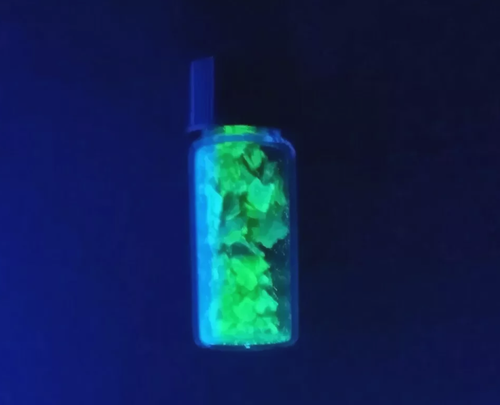


Americium-241 ion chamber containing no more than 0.08 microcuries of Am-241.
Recommended for use as a standard for gamma spectroscopy, or a check source for devices that detect alpha particles. It may not be easily detectable with a beta/gamma sensitive Geiger-Muller tube such as the GQ-GMC-300e+ or GQ-GMC-800.
42 x 4 x 28 mm
Shipped only with USPS Parcel Select Ground (2-8 days). Wrapped in plastic, aluminum foil, and bubble wrap in a box big enough to bring the parcel surface activity below the 0.5mR/h shipping limit. This item will conform to the USPS shipping restrictions when shipped.
The buyer must assume responsibility for this item and use it according to its intended purpose. Keep this away from children and store it at least five feet away from anywhere anyone spends a lot of time.
Geiger counter not included.
Note: By purchasing this item you agree that you have read our WARNINGS and NOTICES! (also serves as FAQ's).
B-72: Paraloid B-72
Paraloid B-72 is a type of acrylic resin commonly used in the preservation and conservation of cultural heritage objects. It is used to protect minerals like Autunite, which can deteriorate over time due to exposure to light, heat, and dry air. B-72 provides structural support to prevent the specimen from disintegrating or turning to dust, though it may not prevent total dehydration.
Reversible, can be removed if necessary. Structural support results in a more rigid and less friable specimen. Conservation grade is widely used for both mineral and fossil stabilization.
Stabilization Instructions
-
Clean using a soft brush and water to remove dust or dirt.
-
Dry the specimen for 24 hours at room temperature. (Wet specimens will not stabilize properly and may develop a white residue).
-
Document the weight before beginning.
-
Mix B-72 with a solvent (Acetone or 100% Ethanol) to a 10% concentration (e.g., 10g B-72 to 90g solvent) and stir until dissolved.
-
Use a dropper or dip the specimen into the solution.
-
Immediately use light puffs of canned air to blow away excess solution and prevent pooling.
-
Allow it to dry completely (several hours).
-
Any remaining white or shiny residue can be removed with a quick rinse of solvent followed by air.
Note: By purchasing this item you agree that you have read our WARNINGS and NOTICES! (also serves as FAQ's).