
Why Do Background Radiation Measurements Fluctuate? Understanding Natural vs. Source Radiation
Oct 19th 2026
Posted by Raymond on Oct 19th, 2026
If you’ve ever left your Geiger counter or scintillation detector sitting on your workbench and watched the readings jump around, you aren't alone. One minute your device is idling at a calm 25 CPM, and an hour later it suddenly spikes to 55 CPM even though there isn't a mineral specimen or other radioactive source in sight.
When you're measuring radioactive sources, these natural background fluctuations can raise unnecessary alarms or throw off your sample readings. Understanding why natural background radiation varies, and how to separate it from your specimen's true activity, is essential for every radiation enthusiast.
What Is Natural Background Radiation?
Every day, we live in a sea of naturally occurring ionizing radiation. Background radiation comes from three main sources:
1. Terrestrial Radiation: Naturally occurring radioactive isotopes found in the Earth's crust, such as Uranium-238, Thorium-232, Potassium-40, and their decay products.
2. Cosmic Rays: High-energy particles originating from outer space and the sun that constantly bombard the Earth's atmosphere.
3. Atmospheric Radon Gas: Radon gas (Rn-222) and its progeny produced by the natural decay of uranium in soils and rocks which vents into the surrounding air.
Your radiation detector is sensitive enough to pick up all three. Because these sources are dynamic, your baseline "background measurement" is always changing.
5 Reasons for Baseline Radiation Fluctuation
1. Barometric Pressure & Weather Changes
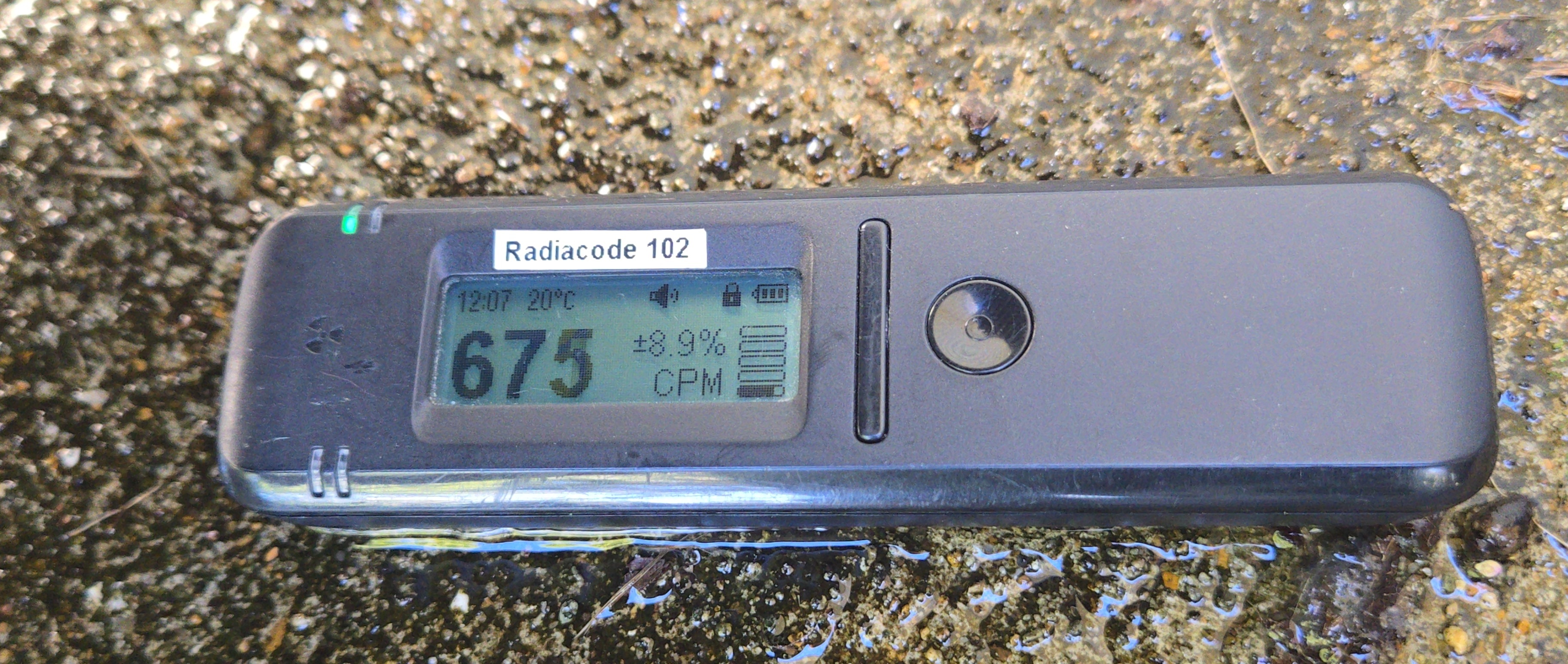
Atmospheric pressure acts like a physical shield against cosmic radiation. When a low-pressure weather system moves in, the atmospheric shield thins slightly, allowing more cosmic rays to reach ground level. Additionally, rain and snow can wash atmospheric radon decay products out of the air and deposit them onto the ground, causing temporary background spikes known as radon wash.
2. Ventilation and Indoor Radon Accumulation
If your workspace or mineral display room is kept closed up, radon gas and its progeny emanating from regional soil (or nearby mineral specimens) can slowly accumulate. Opening a window or turning on an exhaust fan can cause indoor background levels to drop back down to baseline.
3. Cosmic Ray Spikes & Solar Activity
Cosmic radiation varies with altitude, latitude, and solar activity. Solar flares and coronal mass ejections can cause brief surges in atmospheric cosmic ray intensity, which show up on sensitive energy-compensated counters and scintillation devices.
4. Poisson Distribution (Quantum Randomness)
Radioactive decay is inherently probabilistic. Even in a perfectly sealed and shielded environment, radioactive atoms decay at random intervals. Over short counting intervals (like a 1-second or 10-second window), random statistical variance will naturally cause the display to bounce up and down.
How to Separate Background Noise from Your Specimen
When taking measurements of mineral specimens or other point sources, you must account for the ambient background reading to get an accurate measurement.
Step 1: Take a Long Baseline Reading (Long Count)
Before bringing a sample near your detector, leave the device running in the same room for 10–15 minutes to calculate an average baseline background reading (e.g., 15 CPM).
Step 2: Use Net CPM for Accuracy (Background Subtraction)
When measuring your specimen, subtract your baseline background count from your total count:
\[ \text{Net Count} = \text{Gross Specimen Count} - \text{Ambient Background Count} \]
If your sample reads 180 CPM and your ambient background is 15 CPM, your specimen's net activity is 165 CPM.
Step 3: Maintain Distance Consistency
Background radiation is isotropic (it comes from all directions around you), whereas your specimen acts as a point source. Because radiation follows the Inverse-Square Law, moving a specimen even an inch closer or farther from the detector probe dramatically alters your measurement far more than any background fluctuation ever will. For this reason, using a contact measurement (with a distance as close as possible to zero) is the easiest method of maintaining high precision or repeatability.
Rare External Interference Sources
Beyond natural environmental factors, several unusual external sources can unexpectedly trigger or alter your radiation readings. For example, a neighbor or passerby who recently underwent a nuclear medicine procedure (such as a heart scan using Technetium-99m, or Iodine-131 therapy) can emit enough transient gamma radiation to briefly register on sensitive equipment even from inside a passing vehicle. Nearby neighbors medical or dental clinics operating unshielded X-ray devices can also cause temporary spikes if high-energy scatter reaches your workspace. On the atmospheric scale, rare natural phenomena like Terrestrial Gamma-ray Flashes (TGFs)-intense, millisecond-long bursts of gamma rays produced by electrical fields during severe thunderstorms-have been known to cause sudden, brief counts on sensitive detectors. Finally, non-radiological interference, such as Electromagnetic Interference (EMI) from unshielded electronics, power transformers, high-voltage lines, or strong RF signals, can induce false electrical pulses in a Geiger counter's circuitry (often called "ghost counts"), mimicking a sudden increase in radiation.
Summary
Fluctuations in your detector's baseline readings are completely normal and expected. Weather events, ventilation, cosmic ray bursts, statistical decay randomness, and even neighbors can all play a role in shifting ambient radiation levels.
By taking a proper ambient baseline before every testing session and calculating net activity, you can reliably separate natural environmental noise from your mineral specimens every time.