
Can you mail radioactive material?
Sep 22nd 2026
Flashback to March, 2022 by Jeff
You can mail radioactive material if it's done by the book and, of course, safely. Here we will concentrate on how to mail radioactive materials that require no special license that one need apply for nor be individually granted such as a raw, unprocessed uranium or thorium ore-containing geological specimen. Note that we are not an official source of information on this topic and things change, so the most foolproof way is to wade through Code of Federal Regulations (CFR) of the Nuclear Regulatory Commission (NRC).
Mailing Radioactive Materials: Raw Geologic Specimens
The scope of this article will be confined to mailing a small amount of raw, unprocessed, geologic ore. This is due due to the very complicated and misunderstood world of everything else other than a few items like vintage uranium glass, Fiestaware, radium timepieces, or thorium lantern mantles. We urge you to read the area below titled “Why 10 CFR 40.22 is Probably Useless to You”, appended as a post script to the bottom of this article. There we attempt damage control to dispel routinely common misconceptions about what's legal to own or do, period.
NRC Requirements for Mailing Radioactive Materials
The NRC calls radioactive materials “Class 7” materials. In general there are all manner of restrictions, requirements, licenses, papers, containment, and labels involved with this sort of thing. Fortunately, exceptions exist for the lesser extreme materials in limited quantity such as “49 CFR § 173.421 - Excepted packages for limited quantities of Class 7 (radioactive) materials”. This is the one of the keys to legally mailing hobby or educational quantities of radioactive ore.
The NRC requires two main things:
-
Surface Activity Limits: The surface activity anywhere on the parcel's exterior must not exceed .5mrem/hour (0.005 mSv/hour). Since even perfectly calibrated but differently designed Geiger counters and other devices can display vastly different readings due to probe surface area and many other sensitivity factors, we sought what the standard was for measurement. We didn't want it to be a “pancake” probe but then go using a lesser sensitive tube, ourselves, thereby underestimating what an authority would read. It turned out there was no standard in the CRF. A memorandum buried in Division 8, “Occupational Health,” of the NRC’s Regulatory Guide series and NUREG/CR-5569, “Health Physics Positions Data Base” answered this as a sort of FAQ stating that essentially any reasonable, reliable means is sufficient to determine compliance with surface activity limits (presumably calibrated and certified or certifiable by the NRC). So this indicates a standard beta/gamma “hot dog” probe on a Geiger counter should be sufficient, versus more sensitive probe or device. Just to be safe the author uses an end-window probe with a sensitivity somewhere between the two.
-
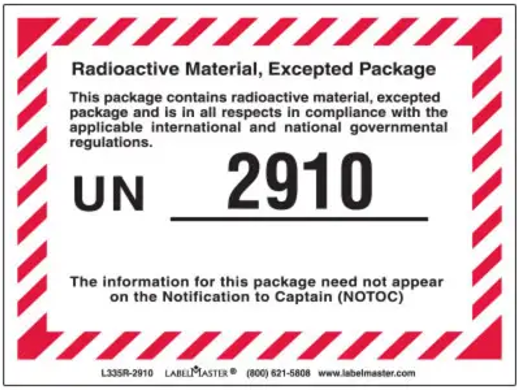
Package Markings: “RADIOACTIVE LSA” must be printed visibly somewhere reasonable in relation to the address etc when mailing radioactive materials . Note that carriers may require additional labeling, such as displaying the appropriate UN number (in this case UN2910), but the NRC, itself, requires just this, for packages excepted under 49 CFR 173.41. They are exempt from needing DOT diamond-shaped transport labels or anything else like papers.
Airmail & Transport Regulations
Here's where things get just a little tricky if you want to go airmail. When mailing radioactive materials, even under these exceptions, air transport is actually prohibited – under one condition – the nature of the package in which it's contained.
49 CFR § 173.427 (a) (6) (vii) states:
“Transportation by aircraft is prohibited except when transported in an industrial package in accordance with Table 6 of this section, or in an authorized Type A or Type B package.”
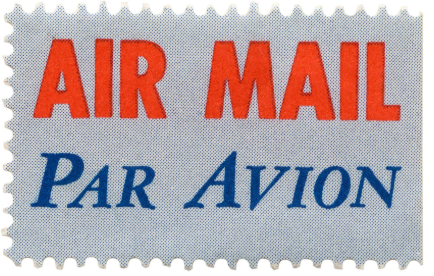
Well, after a couple of tables referring to one another this leads to it needing to be contained in a “Type IP-1” (Industrial Package – Type 1) package. While this, at first, sounded intimidating like something Bruce Willis would be trying to open and disarm, it simply seems to define something reliable not to fall apart (but you be the judge of the code copy/pasted below). After all, if air mail was simply prohibited, a very common air mail label would not exist:
IP-1 is defined below:
49 CFR § 173.410 - General design requirements – skip to section (i):
(i) For transport by air -
not be impaired if the package is exposed to ambient temperatures ranging from −40 °C (− 40 °F) to + 55 °C (131 °F); and iquid contents must be capable of withstanding, without leakage, an internal pressure that pro duces a pressure differential of not less than the maximum normal operating pressure plus 95 kPa (13.8 psi).
If you feel your package is compliant with IP-1 definitions (with your item in them) and it gets returned with an “Airmail of Class 7 Materials is Prohibited – Return to Sender” admonishment, try sending it again with additional labeling stating that it is compliant with 49 CFR § 173.427 (a) (6) (vii) by way of being an IP-1 container thereby allowing its contents to travel by air.
USPS Requirements for Mailing Radioactive Materials
USPS aligns with the NRC's requirements, but they require a specific statement, below. Other carriers have their own rules but similar or identical. USPS requires:
-
“RADIOACTIVE” in which case the NRC's required “RADIOACTIVE – LSA” will suffice
...in addition to (and this can go just underneath RADIOACTIVE – LSA):
This package conforms to the conditions and limitations specified in 49 CFR 173.421 for radioactive material, excepted package—limited quantity of material, UN2910, and is within Postal Service. activity limits for mailing.
Package Size per USPS is stated as:
“No single dimension of the external mailpiece can be less than 2.5 centimeters (1 inch), and the length and girth (combined) can be no less than 30 centimeters (12 inches)”.
It should be noted that it costs about the same to mail a 6x4x4” or 5x5x5” box as it does a compliance-iffy envelope. If you're doing the wonderfully inexpensive First Class for something under a pound, and it's likely to go airborne, it may be worth it to go with the box esp. if you're going to claim it's package type IP-1 compliant when bearing its particular contents. At least if it's not going to kill your profit on some low priced nugget, in which case you might want to look more into IP-1 definitions.
Summary for Mailing Radioactive Materials via USPS
-
Parcel surface reads no more than .5mrem/hr and at least 1 inch thick.
-
It bears the following:
RADIOACTIVE – LSA
This package conforms to the conditions and limitations specified in 49 CFR 173.421 for radioactive material, excepted package—limited quantity of material, UN2910, and is within Postal Service. activity limits for mailing. -
If it goes airborne it's supposed to be a Type IP-1 package to be excepted from being prohibited from air transport.
-
It's good practice to include the airmail label pictured above with the red airmail hashmarks (that's what those mean – it's an air mail notice).
What follows is a plea for people to slow down and think more and read more about what they do, instead of relying on wishful thinking or word of mouth. The codes can be deceiving.
Why NRC 10 CFR 40.22 is Often Useless to You
The reason we did not stray beyond the topic of raw, unprocessed, geologic ore specimens (and perhaps uranium glass, thorium lantern mantles, radium watch hands or Fiestaware) is because the CFR is immensely complex and full of surprises when it comes to anything else such as depleted uranium, crushed ore (mining tailings), thorium dioxide, and others.
It's amazing what people think is legal because of the initially, deceivingly permissive-sounding tone of “NRC 10 CFR § 40.22 Small quantities of source material”. A quick read and many a shared opinion of what it all means makes all manner of things appear legal to people, at first, but they wind up being anything but legal (largely due to relatively unfortunate verbiage in other areas, or local laws).
Do not be fooled. Everything we just mentioned in italics, above, is illegal for most people to own and esp. for almost everyone to send one another, despite how 40.22 sounds at first. The internet is not devoid of folks selling these items simply because no one thinks to sell them or knows where to get them. It's because people get busted. Years can go by after things “cool off” – another factor lulling people into false sense of security or legality.
Here's what kills most of 40.22's would-be promises of allowing trade of pounds of DU etc. etc.:
-
There are 38 Agreement States with their own, state possession laws.
-
40.22 applies to institutions not individuals.
-
Part (e) was added in 2013 which hamstrings the ability to send any of it to one another. Places you see selling DU, calibration disks etc. have licensed senders like Spectrum up their sleeve. You're not even allowed to give a licensed calibration disk to another person. That's “transfer”.
-
Nothing in 40.22 allows making anything new out of ore or performing major experiments, both which require huge budgets, permission, and inspections.
These factors change everything a lot of people think when they read 40.22 and, between this and the EPA people are struck with surprise criminal indictments, half million-dollar home remediation cleanups and, sometimes at the very least – total recalls of all pieces sold, with seller owing refunds and fees. We will attempt to tackle this convoluted topic in another article but since some legal ore is more active than those things, anyway, why tempt fate anyway?
Definitely don't try to build any kind of reactor! “The Radioactive Boy Scout didn't get in much trouble” is the farthest thing from the truth, as well. He who attempted a reactor caused a costly cleanup catastrophe and increased innocent bystanders chances of eventual cancer, he whose mom committed suicide and he who's now, also dead from an alleged drug overdose after being known to start up again, no doubt requiring additional surveillance and resources...(?). Anyone following in his footsteps will be a poster child example with all book thrown at them and all their associates made persons of interest. Not to mention an EPA home remediation (occupation and cleanup) can cost $200,000 or even $500,000. Even harmless, education and safety advocating professor George Dowell unwittingly committed a special crime prying an Am button from a smoke detector thereby freeing it of its specially licensed existence and was pursued.
Don't listen to happy go lucky kids or forum-goers who look over 40.22 and think it allows exotic materials, performing experiments, or even using ore to make simple, new objects without elaborate permits. Gluing otherwise legal ore together into a Buddha with a clock on his chest? Manufacturing! Processing. Illegal.. Do direct federal and state research. Assume nothing.
The biggest piece of advice we can give is: realize there are parts of the CFR that appear to allow things but which are worthless in light of other parts that disallow them, like 40.22 sounding great until state law makes the same material illegal to own and 40.22 (e) makes it illegal to sell or give any of it to anyone (the part they added six years later because they were embarrassed at sounding too permissive and liberal and adding a caveat that ruined 40.22 was easier than revoking or modifying it otherwise). The prohibition code will always trump the seeming permission code unless an exception is explicitly excepting or exempting another area, specifically.
The regs are so convoluted they confuse even the NRC itself so often there are countless “memorandums” attempting to clear it up for their own employees and associates.
That said, we have nothing against the NRC who protects and helps many people. They don't just help prosecution and enforcement, they'll help defense, too. And they are known for sizing up good people for honest mistakes and issuing warnings, but that can still be devastating when you have to recall all your items sold, and they've got to help protect both the people and their own butts. They've been instrumental in helping us understand the CFR and hypothetical situations.