
Radon (Progeny) Detection with the Radiacode 102 or 103
May 17th 2026
Originally posted April 18, 2025 | Updated May 17th 2026
This article outlines a method for inferring and confirming the presence of radon gas with the Radiacode 102 or 103. This approach allows for qualitative detection without a dedicated radon detector by analyzing an exposed air filter in a low-background environment over a period of several minutes. As radon in the air decays, its daughter products can become trapped in the air filter, making it a temporarily contaminated source for testing. Radon progeny are often electrically charged, making them more likely to attach to airborne dust, aerosols, and filter media.
Since radon progeny may undergo alpha, beta, and/or gamma decay, we can use the Radiacode 102 or 103 to demonstrate the decay of the gamma-emitting progeny Pb-214 and Bi-214. Both have half-lives of less than 30 minutes, necessitating several hours to complete this series of automated measurements.
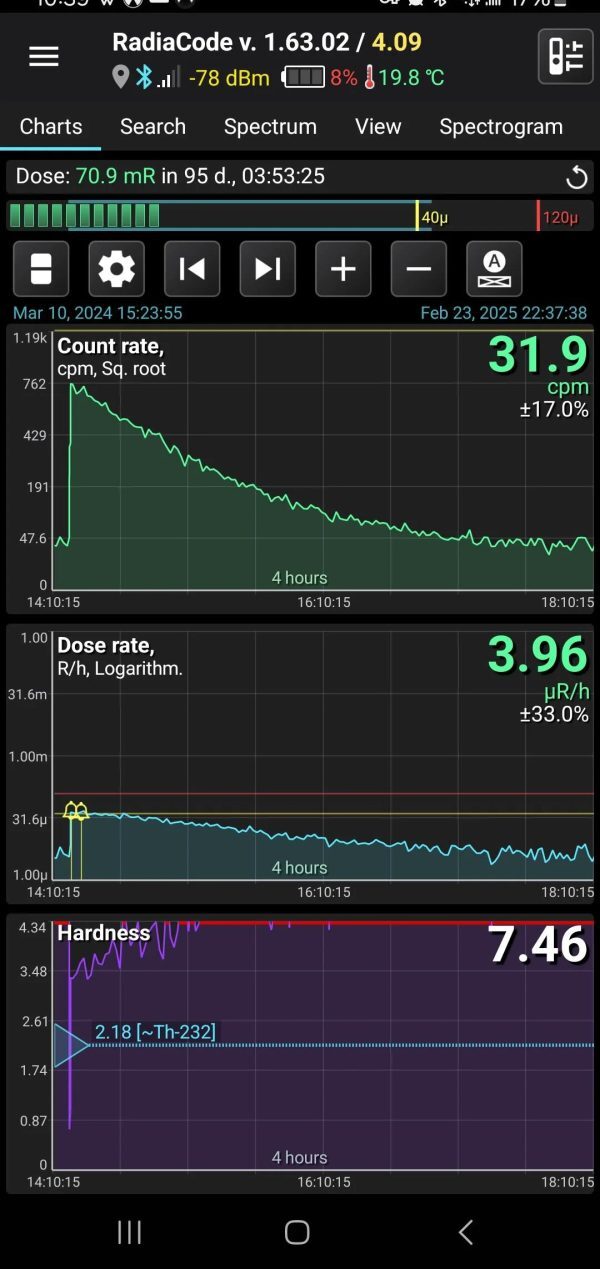
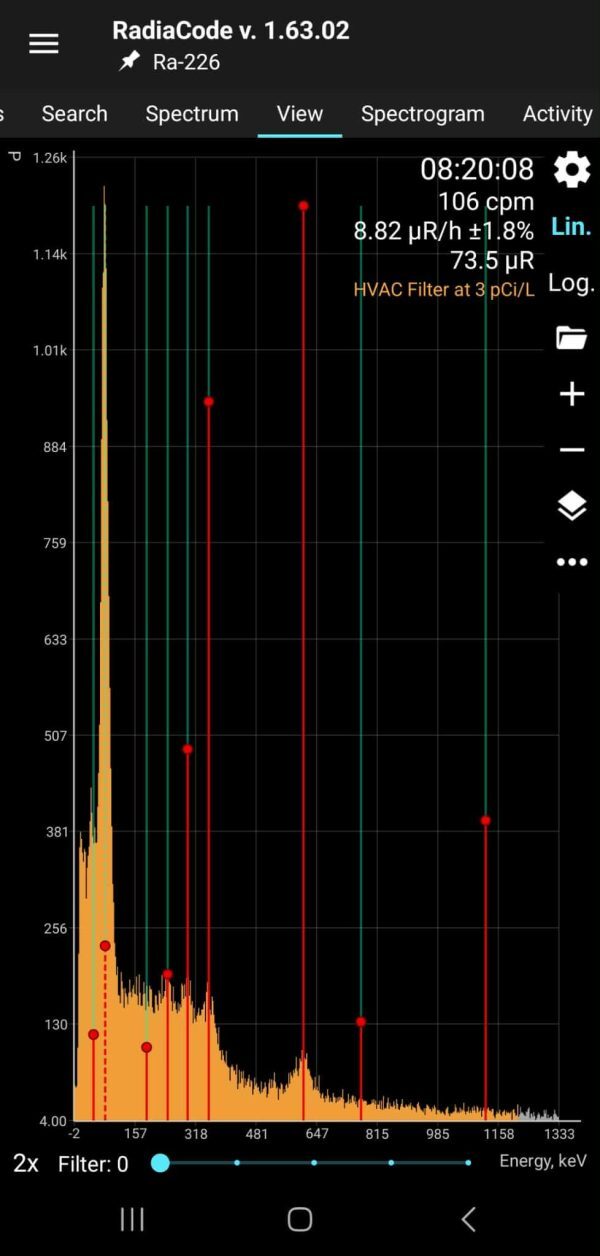
A steady logarithmic decrease in the count rate over time can indicate the presence of radon daughter decay. Furthermore, we can confirm the presence of radon daughters by identifying the characteristic gamma emissions of Pb-214 (295 keV and 352 keV) and Bi-214 (609 keV) from the Radiacode spectrum measurement. It should be noted that the logarithmic decay observed will not correlate to a specific radon progeny half-life, since more than one radionuclide will be detected simultaneously.
Please Note: These instructions are intended to demonstrate the general method of detecting and confirming the presence of radon progeny with the Radiacode 102 or 103 via its mobile app (available for Android and Apple devices). This procedure was successfully used to confirm the presence of radon progeny when a fiberglass air filter was exposed to a known radon concentration of 3 pCi/L for 15 minutes, as shown in the accompanying images. This procedure cannot be used to quantify radon levels.
Required Materials
-
Radiacode 102 or 103
-
One new fiberglass air filter
-
Air filtering device (e.g., a fan with a filter)
-
Lead shielding (if necessary)
- A variation of this procedure uses a vacuum cleaner and a sock in place of the air-filtering device and filter.
Procedure
1. Expose the Air Filter
-
Place the new air filter into your air-filtering device. It is not necessary to perform this testing with a dirty air filter, as using a clean filter will produce sufficient results.
-
Run the fan for 10 to 15 minutes to circulate the air in the environment you want to test and to collect potential radon progeny on the filter.
2. Measure Background Radiation
While the air filter is being exposed, measure the normal background gamma radiation count rate for the same location where the exposed air filter will later be measured.
-
Power on the Radiacode device and connect it to the mobile app.
-
In the Spectrum tab, tap the three-dot menu and select Restart Accumulation. This will reset the average count rate displayed near the top of the Spectrum tab.
-
After approximately five minutes, note the new average count rate displayed on the spectrum screen.
-
If the average background count rate is above 100 CPM (counts per minute), lead shielding may be required to better demonstrate logarithmic decay and enhance the spectrum peaks.
-
In this example, the average background was 288 CPM, so 3/8-inch-thick lead shielding (in the form of two lead pigs) was used to reduce the background below 30 CPM for the final measurement.
-
If using lead shielding, repeat this background measurement step with the shielding in place and record the shielded background count rate.
3. Measure the Filter
-
After the air filter has been exposed for the required amount of time, carefully remove it.
-
Cut out a strip of the filter measuring approximately 2 × 10 inches.
-
Wrap the exposed filter material around the detecting end of the Radiacode device.
-
Insert the filter-wrapped device as far as possible into one of the lead pigs (if using shielding), ensuring the filter sample remains positioned at the detecting end of the Radiacode device.
-
Fully enclose the filter-wrapped Radiacode device by placing the second lead pig over the remainder of the device (if using shielding).
-
With the Radiacode device connected to the mobile app, select Restart Accumulation to reset the spectrum and average count rate.
-
Observe the starting count rate. Keep the spectrum running until the instantaneous count rate approaches the background count rate. In this example, this process took approximately 8 to 10 hours, beginning with an instantaneous count rate around 700 CPM.
-
To read the instantaneous count rate, switch to the Charts tab. The value is displayed on the top chart.
-
Once the spectrum measurement is complete, select Save Spectrum to Library from the three-dot menu in the Spectrum tab.
-
Save the spectrum and switch to the Charts tab. Adjust the visible time frame so that the entire testing period is visible on the chart.
-
Take a screenshot at this point to preserve the chart for future reference.
Interpretation of Results
Radon Progeny Not Detected
If the starting count rate is similar to the background count rate, it suggests that no significant amount of radon progeny was detected on the filter.
Radon Progeny Inferred
If the starting count rate is substantially higher than the background count rate, and a steady decrease in the count rate over time is observed on the chart, radon progeny decay can be inferred. This strongly suggests that radon gas was present in the air being filtered.
Test Invalid
If neither of the above situations applies, there may be an issue interfering with the analysis. Repeat the procedure, paying close attention to the background measurement and ensuring proper setup.
Radon Progeny Confirmed
If distinguishable peaks are observed at approximately 295 keV, 352 keV, and 609 keV in the saved spectrum, and radon progeny has already been inferred by a decreasing count rate, you can confidently conclude that radon progeny has been detected. However, the concentration remains unknown. A dedicated radon detector should be used to quantitatively determine the radon gas concentration.
Conclusion
This method provides a practical and accessible way to qualitatively infer and confirm the presence of radon gas by detecting its short-lived progeny using the Radiacode 102 and 103. While it is not a substitute for quantitative radon testing with a calibrated detector, this process effectively demonstrates the principles of radioactive decay, particularly for gamma-emitting daughters such as Pb-214 and Bi-214. By minimizing background radiation and observing both spectral peaks and count rate decay, users can gain meaningful insight into potential radon exposure in their environment and obtain solid supporting evidence for the necessity of major purchases for future quantitative testing.